
Showing posts with label field books. Show all posts

Sunday, October 12, 2008

The 2008 Dig Has Finally Begun!


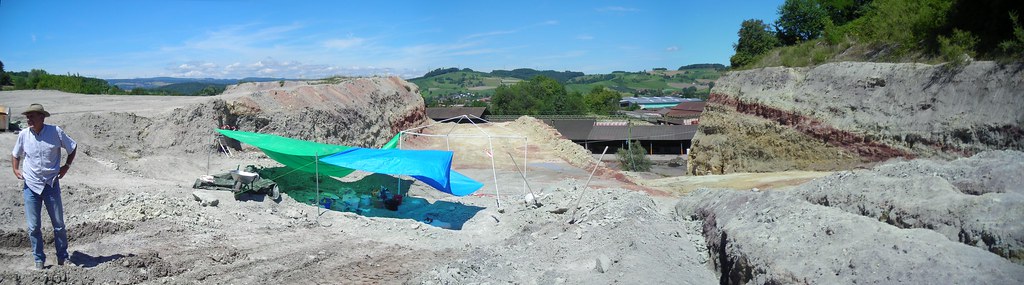
Yes, this year's dig has finally begun. After removing some 100 cubic metres (3'500 cubic feet) from the top layer, we have cleared about 300 square metres (3'000 square feet) of the dinosaur-yielding stratum. During this, we found remains on six different locations from what looks like at least five different specimens! Two of these are actually some missing parts of two specimens we dug out last year, so this makes it three new specimens.

Our team this year consist of a pool of about 10 people, with 4 to 6 people on the dig at a time. They are: Dr. Ben Pabst, the boss on the dig and a very experienced digger and preparator; Georges, Fritz and Hans-Joerg, local fossil hunters; Josiane, a master student in geology and paleontology from Zurich University; Lukas, an archeology student; Emanuel, Nicola, Andrea and myself, all people from the Aathal Dinosaur Museum (and in part also master or grad students). Most of us have already experince in scientific excavations and some have even participated in the digs at Howe Quarry in Wyoming (which is the Aathal Dinosaur Museum's own digging site).

This last two weeks, the weather has been very typical for the season with fog in the morning and sunny afternoons with some interspersed rain showers and temperatures around 10-15° C (50-59 F). It remains to be seen how much can be done before the november rains set in and winter comes. Already, the snow limit is creeping down the mountains (at one point last week, it has been at around 800 metres or 2400 feet...).


> Photos from the 2008 dig.

It looks like we have come across at least one fairly complete specimen (specimen 08/5), of which we have already dug out 30% including one leg, both arms and shoulder blades, parts of the neck and skull as well as some ribs.

One other specimen (specimen 08/4) has so far yielded one completely articulated leg and part of the tail. This one looks promising; more could hopefully turn up as we dig further in.

Then we have found a hand and some ribs of a third specimen (specimen 08/3). It's unclear whether ther's more since we haven't even begun digging that one out so far.

And of course we have found some missing parts from two specimens we dug out last year, that is specimen 08/2 (which actually belongs to 07/N, dubbed "Big Frick" or "Thunder") and 07/M (on which I currently work). 08/1 were some isolated bones which can not be atributed to any of the above mentioned individual specimens.


More videos from the dig are to come soon!


Sunday, October 5, 2008

Update Concerning The 2008 Dig


For my readers who have eagerly waited for news on this year's dinosaur dig, here are finally some news:

This year's dig was originally scheduled for september but due to the ongoing preparation and mounting of last year's plateosaur for the Dutch National Museum, it has been put off by several weeks.

Now finally, the work has begun: We are currently clearing out a surface of 300 square metres (over 3'000 square feet) with heavy equipment in order to look for new bones. Already, we have moved over 100 cubic metres (3'500 cubic feet) weighing about 270 metric tons (300 short tons).

> Our excavator.

So this far, we are just doing the reconnaissance, the real digging has not yet begun. However, we expect finding at least some new dinosaur remains. So in the next week or so, as soon as we are actually digging up bones, I will begin giving you regular updates on what's going on!

> The two mounds in the middle ground are the top sediment layer we have already cleared.

I have already taken some photos onsite but also from the preparation and mounting of the 2007 find which I will upload in the next couple of days. Above you can see a couple of 'em.

We hope that we can work at least to the end of october before the heavy november rains set in and before the first december snowfalls. However, this last week has already been quite rainy and cold for a season that is usually partly foggy, partly sunny with temperatures around 10-15° C (50-59 F). Already the snowline is declining in the Alps; it is currently at a bare 800 metres (2'400 feet).


Friday, July 25, 2008

2007 Dinosaur Dig In Frick, Switzerland


The 2007 dinosaur dig was conducted by an international team under the direction of Dr. Ben Pabst from the Aathal Dinosaur Museum. Apart from the Swiss, the team of about a dozen paleontologists included Dutch researchers from the National Museum of Natural History in Leiden, Netherlands (which financed the dig) as well as German colleagues from the Bonn University.

> Overview of the main site in the Frick Clay Pit.

The dig lasted from may through october and was very successful. That spring, by chance, an amateur paleontologist had discovered a new outcrop on a building site roughly one kilometre (three quarters of a mile) from the Frick Clay Pit. So the dig actually included two separate sites; the main site in the Frick Clay Pit which covered about 500 square metres (4500 square feet) and the building site which covered about 50 square metres (450 square feet).

The two outcrops yielded two specimen each; one very complete speciment from the building site (dubbed "Monica") and one very large animal of 7 to 8 metres (21 to 24 feet, dubbed "Thunder") from the main site. This latter find represents the largest skeleton found in Frick to date. Noteably, the 2007 dig also provided many articulated hands, a find that is rather rare and which is of some importance for the study of the anantomy of these dinosaurs. Ben Pabst remarked that we had actually found more (articulated) hands that year than in the 30 previous years combined.

> An articulated lower arm and hand of a plateosaur.

The excavation at the building site proved to be somewhat interesting; the strata on this site stand at an angle of approximately 70° and are thus going rapidly deeper below the foundation of what was to become a family home. As this was a building site, we only got a short time to unearth the fossils; at one point towards the end, the building site got flooded due to a summer thunderstorm. We had to organize for a water pump, a generator and some floodlights an had to finish the dig all through the night.

On both sites, the preservation of the bones proved to be excellent. The complete specimen from the building site is currently prepared and mounted and will be sent to Leiden this august, where it will be on display in the National Museum of Natural History. For some photos of the specimen, see this post.


> Fotos from the 2007 dinosaur dig in the triassic site of Frick, Switzerland. You can also watch the fotos as slideshow.


The 2007 dig made quite a splash in the international media which reported that the “largest dinosaur site of Europe“ with “hundreds“ or even “thousands“ of dinosaurs had been found. As usual however, the media misreported what had actually been said at a press conference and then one journal copied the story from another, further distorting it and so on.

What actually was said on the press conference was this: Based on 30 years of research in the main site, we can estimate that there is one skeleton to be found for every 100 square metres (roughly 1000 square feet). As there are now three known sites* in a 2.5 kilometre (1.5 mile) diametre around Frick, it can be speculated that the Frick area may have one of the largest accumulations of dinosaurs from this period in Europe. The problem though is that the concerning strata only crops out in few places in the area; so even if true, that doesn’t mean that hundreds of dinosaurs are going to be unearthed anytime soon (read: at all).

> Getting the bones out.

Anyway; we got quite a lot of press coverage, many visitors and we were even visited by a Dutch camera team. Also, Martijn, one of our Dutch colleagues made a blog from the dig (not unlike the one you are currently reading).

(* The third site was discovered about 10 years ago by myself and yielded some plateosaur remains too. However, there never was any excavation on that site).


Friday, July 4, 2008

2006 Theropod Find In Frick, Switzerland


In 2006, for the first time in Frick, Switzerland, the remains of a small theropod were unearthed. Apart from the missing hind legs and skull, the find is relatively complete and well preserved. The find was excavated and prepared by Dr. Ben Papst. The complete specimen would measure approximately 2.5 metres (8 feet).

> Reconstruction of a Liliensternus liliensterni, one of the members of the coelophysoid theropods.

The 2006 specimen is currently in the Paleontological Institute and Museum of the University of Zurich for further investigation. The scientific determination is pending. It surely belongs into the group of coelophysoid theropods; thus it could be a Coelophysis, a Liliensternus, an other known species or even a new species from that group. The specimen is later to be on display in the Frick Dinosaur Museum.


> Fotos from the 2006 coelophysoid find. Note the small 4th finger of the specimen. You can also watch the fotos as slideshow here.

This find is relatively important since it is one of only 4 or 5 finds of it's kind in Europe and the only one from Switzerland. One important feature of the 2006 find is that it has three fully formed fingers and one smaller one. It could thus mark a missing link in the evolution of theropods who reduced their fingers from 5 to 3 early in their lineage.

Learn more about the Frick, Switzerland site here